Garveyism at the end of the Long 20th Century: Amos Wilson designs the Blueprint
This article explores Dr. Amos Wilson’s “Blueprint for Black Power” as a contemporary extension of Garveyism, highlighting the need for Black nation-building grounded in scientific analysis and psychological decolonization. Wilson challenges the myths of integration and Black capitalism, urging a shift toward African-centered consciousness, cultural renewal, and collective economic action. Through a critical examination of history, economics, and sociopolitical realities, the article situates Wilson’s work within ongoing struggles for Black empowerment and self-determination. Ultimately, it underscores the relevance of Wilson’s vision for addressing the complex challenges facing Black communities in the 21st century and beyond.
Jerome Louison
6/6/202615 min read
"If other nations and other people require libraries to deal with their issues, so do we."
- Dr. Amos N. Wilson
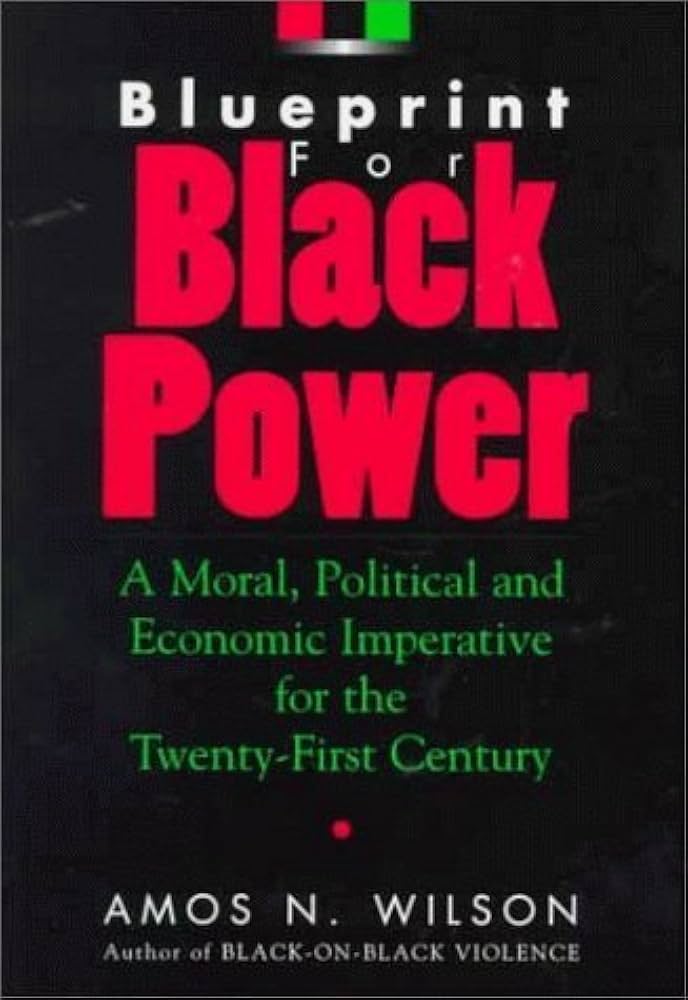
The reception from the small crowd, as always, was warm. Dr. Amos Wilson approached the podium, full suit and kente stole in tow. The lecture that night would be in anticipation of his latest publication: Blueprint for Black Power. The first thing he notes is the book’s length. At last count, the manuscript was well over 800 pages, an epic treatise on history, psychological theory, sociology, economics, and political analysis. Even more impressive (although he doesn’t state it), this “survey,” as he describes it, would be published independently. Before e-books reduced the barrier to entry, Dr. Wilson and his team at Afrikan World InfoSystems would complete this enormous endeavor. The good doctor jokes that his team thought of splitting the work into two, about 400 pages each (they would ultimately keep it to one book)—some light reading for the fall.
Why take on such a task? As Dr. Wilson notes, if one is serious about Black liberation, then one must think in terms of nationhood, of nation-building. And nation-building requires studying Black life through every conceivable scientific lens. Science, not mythology. For Dr. Wilson, the most pervasive myth was the myth of integration:
“It is a fantasy that has kept us from taking care of business for far too long, the idea that we are gonna one day be one with these people.”
These people, of course, referred to those who proclaimed themselves white. The progeny of Europe, who left the Old World in search of, let them tell it, a better life. That better life would turn Turtle Island into the "shining city upon the hill,” but not before the enslavement of millions, the genocide of entire civilizations, and the crippling of several continents. Black people could not be like them. Nor could we simply be ourselves, given the generations of indoctrination that followed the kidnapping of our first ancestors from the mother continent, through the Maafa, and onto the plantation. What was needed was a new outlook. A new worldview. A new consciousness.
Exorcising the Colonial Spirit: The Wilsonian Theory of Consciousness
“The most practical thing you can have is a good theory…”
Amos Wilson
Dr. Wilson warns the audience that they are possessed, possessed by spirits and demons. This is the reason Black people in America and around the world do not see themselves as African, by and large. African names, African languages, African spiritual systems–they all sound strange and foreign. The solution for Dr. Wilson, and the first major step in seizing power, was to conduct an “exorcism.” In actuality, he is calling for decolonization. The African-centered, or neo-Garveyite, position expressed by Dr. Wilson declares that without a decolonized worldview, all liberation programs will fail outright or be easily absorbed back into the white supremacist structure.
Dr. Wilson, a psychologist by training, focuses the first hour of his lecture on consciousness. On how it is formed, and its effects on the human mind and body. He does this because consciousness is not the exclusive property of the individual. Others can control it. This is the possession alluded to earlier. Dr. Wilson highlights several forms of possession to illustrate the quality of the colonized consciousness. Case in point, somnambulism. This is sleepwalking. One is performing tasks but is unaware of the performance. Almost as if another spirit is in control. The social ills Black people face, especially the various modes of violence (community, interpersonal, gender-based) perpetrated against each other, derive from Black people being socialized into this state. As the doctor states plainly,
“We are killing each other in order to maintain this system.”
To ensure that this cycle continues, there is another element to consider. It is a pervasive talking point for Black folks. It is self-hatred. Our colonized status and the anger it engenders are turned inward. On top of the violence (including self-harm), there’s alcohol, drugs (including gambling, not just hard substances), and other forms of self-destruction. White folks don’t fear this. What they fear is when the object of Black anger shifts. From inward to outward. From us to them. Dr. Wilson refers to a now forgotten case, that of Colin Ferguson, a Black man who shot at white and Asian passengers on the Long Island Rail Road (LIRR), wounding 19 and killing six. For Wilson, this is the ultimate fear that white people have. In our generation, there have been others (Chris Dorner and Micah X, the most prominent among them).
Drawing even further on his experience in psychological research and theorizing, Dr. Wilson asserts that the framework of multiple-personality disorder is useful when identifying the thought processes and behaviors of Black people. With multiple-personality disorder, each personality exemplifies physiological changes as well. They may speak different languages or react adversely to certain foods (i.e., break out in hives when eating a particular fruit). Thus, the colonial personality is in fact multiple personalities, each fighting for dominance within the Black mind. The European-designed personality typically wins, often without us knowing (Dr. Wilson calls this latent possession).
It is important to note that Dr. Wilson is arguing for a scientific, materialist analysis of consciousness. One’s consciousness has physical consequences on the brain, the individual body, and thus the social body. The observed behaviors at every scale (individual, familial, communal) are simply the projection of the underlying consciousness. Change the consciousness, change the behavior.
While he doesn’t use the terms colonial, colonization, or even decolonial in his lecture, echoes of Frantz Fanon and other anti-colonial thinkers are clear. This is an evolution of the original Garvey position. Garvey’s dreams were of empire. A Black empire, but an empire nonetheless. Dr. Wilson was arguing for something different. With nearly a century of hindsight, Dr. Wilson recognized that imperial fantasies in all their forms were a dead end. The result would be greed, a lack of morality, and, ultimately, self-destruction. As he states in the lecture, European and American economies in the 1990s were struggling to produce enough jobs for their own people. There were cracks in the system. These cracks, which have only widened in the 21st century, presented new dangers for Black people, especially within the United States. More and more of us (especially Black men) had become superfluous and redundant to the American social system. This was recognized as far back as the 1970s. The solutions devised by the U.S. ruling class were mass incarceration for the most vulnerable, and Black capitalism (another myth) for the strivers.
Two decades later, the damage of mass incarceration and Black capitalism was visible to all who would see. Interestingly, the most prominent of the Black civil rights groups, the NAACP and Urban League, had little to say about either phenomenon. But Dr. Wilson saw the effects of mass incarceration and offered his theoretical insight. As he and his team worked tirelessly to provide liberatory solutions, one question kept arising: how do Black people attain power on our terms?
An Afrocentric Bloc in a Multipolar World
Culture is an instrument of power.
Amos Wilson
By the 1990s, a brave new world was being discussed in the West. The Soviet Union had fallen, and with it, the prospects for global communist revolution. America now stood alone. This moment is categorized by (some) political scientists as the unipolar world1. When it came to global affairs—from trade agreements to nuclear proliferation—everything went through the United States. With no other nation strong enough to challenge American supremacy, some intellectuals even christened the end of the 20th century as the ‘end of history.’2 But history never ends. Russian-led communism was dead, but self-determination was not. American planners were growing increasingly nervous. The Japanese, for instance, with their technological and business acumen, provided an admirable competitor to American financial capitalism. The Japanese model had limitations, though, ultimately falling into stagflation (for which they have still not recovered), due in large part to American financial pressure. But would another country (or countries) emerge?
On the domestic front, the 1980s had been a horror for millions of Black people within the imperial core. Mass incarceration was in full effect, fueled by war—not a war against people (at least not explicitly) but against drugs. The revolutionary fervor of the 1960s and early ‘70s was a distant memory. So too were the well-paying blue-collar jobs of the post-World War II era. Middle-class attainment in the increasingly service and finance-driven economy was the primary goal. While not possible for the majority, a Black bourgeois class had solidified, riding the wave of government jobs that emerged from the 1960s. As the final decade of the 20th century arrived, the dream of integration was closer than ever. Dr. Wilson was sceptical.
The lecture for Blueprint for Black Power was meant to provide the theoretical underpinning for building a social, political, and economic system to compete with the United States, within the United States. No easy feat, for sure. But for Dr. Wilson, there was no alternative. Having no power base of our own, Black people were at the mercy of others. If the birth of a new century meant our usefulness to the empire was complete, then mass incarceration would be the least of our worries. The time to acquire power was now. But what did power look like for Black people?
It should be clear that Dr. Wilson’s analysis places heavy emphasis on psychological and sociological traits. The tools of power that he mentions in his lecture are not military technology or land, but rather consciousness, personality, and culture. For him, the latter traits are the first principles of power, and like any good theoretician, one always starts from first principles. Heading into the 21st century, Black people had to reevaluate these foundational traits before talking of anything else. The African-centered tradition offered some answers for Dr. Wilson. First consciousness, followed by culture. A new African culture, not static and cherry-picked from centuries past, but dynamic, evolving, and useful. As Dr. Wilson noted,
“What makes it African culture is that it operates in the interest of African people.”
This African culture would not only unite Black Americans but also connect them to Black people globally, especially in the Caribbean and on the African continent. For Dr. Wilson, this Pan-African bloc, home to over 1 billion people across multiple continents, would provide the land, natural resources, labor, and technology needed to compete against both the dying West and emerging East. Again, a shift to the Garvey vision, which sought originally to move Black people back to the African continent. Instead, Dr. Wilson foresaw Black people traversing the TransAtlantic, their location determined by both individual interests and collective need. This was Black nationalism for the 21st century. Bold, yet pragmatic. Still, white supremacy wasn’t the only force foreclosing this Pan-African future. From the 18th century onwards, a new world-system dominated relations between people, nations, and continents. A system that Dr. Wilson, unfortunately, did not interrogate enough. So, what was to be done about this thing called capitalism?
…and what of Capitalism?
Dr. Wilson’s Blueprint was intended for pragmatists concerned with improving the conditions of Black people under the current social order. The very term blueprint is instructive. Unlike many of his contemporaries (and modern radical voices), who spoke of radical visions, Dr. Wilson sought to provide a roadmap to get from the current misery to the proposed new haven of a strong Pan-African political bloc. Dr. Wilson mentions, here and in other lectures, that while he would gladly support a communalist or other anti-capitalist effort, the problem of securing jobs and reducing the social ills that plagued Black communities was paramount. Additionally, vast swaths of Black people (even to the present day) see capitalism as a tool to be used to secure a healthier, more economically secure life for themselves and their families. Any liberation effort cannot ignore this.
That being said, the details matter. Dr. Wilson, in discussing the potential for Black power development, relies upon research conducted by the University of Georgia’s Selig Center for Economic Growth. Since 1990, Selig Center researchers have released an annual Multicultural Economy report tracking what they call the “buying power” of different ethnic and racial groups in the United States. Spending data and consumer surveys define the buying power metric. A recent example should suffice. The 2021 report highlighted that, as of 2020, Black (the report uses the term African American) people’s total buying power was estimated at $1.6 trillion USD. Typically, when buying power is brought up, it is compared with gross domestic product (GDP), a measure of a nation’s productive forces. In that sense, if one is using a nationalist economic framework, Black people in the United States would have been somewhere in the top 15 largest economies in the world in 2020.
But buying power is not GDP. If anything, buying power is as much a measure of consumer debt as productive capacity, as has been argued by researchers such as Dr. Jared Ball3. A better approximation of the “Black GDP” might be the total gross revenue of Black-owned businesses, which amounted to approximately $211.8 billion USD in 2022, the most recent year on record. While this might seem a large number in absolute terms, it is only about 1% of total U.S. gross revenue. Black-owned firms employ 1.6 million people (not all of them Black), with 71% of those firms employing fewer than 10 people. Black-owned firms are also highly concentrated in a few industries, with more than a quarter (~26%) in health care and social assistance alone. About 71% of these firms are in just six sectors of the economy (interestingly enough, arts and entertainment is not one of the six)4.
Thus, the picture of Black capitalism is that of a marginal segment of the American economy, which employs relatively few and generates more competition and consolidation than cooperation and diversification. The numbers were no different in the 1990s. However, simply knowing these facts does not bring us closer to actionable items. The practicality does, in fact, matter. In Dr. Wilson’s own words, though, sometimes theorizing is the most practical exercise one can engage in.
With respect to navigating the American capitalist system, this is especially true. According to Dr. Wilson, the African American nation is a monoculture, selling one product to the world: labor. Mainstream development economics would either argue in favor of the monoculture strategy, under the guise of comparative advantage, or would suggest import substitution, investing in domestic products and services to replace those purchased abroad. Dr. Wilson, like most Black nationalists, essentially argued for import substitution. However, as the empirical evidence shows, that approach has garnered more rhetorical than financial support among the masses of Black people, despite the romance surrounding the support of Black businesses. Something else is needed.
For that, we must go back and retrieve. San kɔfa! In the 1930s, W.E.B. Du Bois (Garvey’s old nemesis) recognized that Black people were in a similarly uncertain and fragile position. The Great Depression and consecutive world wars threatened to reverse whatever gains had been made toward racial equality. Du Bois would partially adopt Garveyite nationalism to conceptualize a new theory of social and economic development. He called it the cooperative commonwealth. It was a rejection of the American Dream in favor of humility, high art, and collective uplift. It did not take hold in the African American political imagination, largely because of his split with the NAACP and the larger Black bourgeoisie. Three decades later, cultural critic Harold Cruse would argue that Du Bois’s vision needed to be rediscovered and reimagined for that moment. Cruse called his economic approach new institutionalism. As he conceived it, the main purpose was to “...intelligently blend privately-owned, collectively-owned, cooperatively-owned, as well as [state-sponsored] organizations.”5 Dr. Wilson draws extensively on both thinkers in his Blueprint. Wilson’s economics, however, does not advance their efforts.
It can be argued (and some thinkers have) that this reluctance to completely divorce from capitalist orthodoxy represents a limitation of Garveyism. Harold Cruse reached a similar conclusion in the 1960s, writing that, despite Garvey’s positive elements as a nationalist thinker, Garveyite economics lagged behind that of its contemporaries. For comparison, Cruse used the early-20th-century Chinese nationalist intellectual, Dr. Sun Yat-sen. While Garvey was attempting to develop a “collective” capitalist path to empire, exemplified by the Black Star Line, Dr. Sun had already departed from this path, increasingly embracing an anti-imperialist, socialist economic system that would rapidly transform the poor agrarian nation into an economic powerhouse. This vision would pass to Mao Zedong, chairman of the Chinese Communist Party (CCP), with his Great Leap Forward (marked by unprecedented progress and tremendous suffering), and then to his successor, Deng Xiaoping, who pushed through major reforms to the Maoist system, laying the groundwork for what today is called socialism with Chinese characteristics. That theoretical frame has produced the largest anti-poverty program in world history, lifting almost 800 million people out of absolute poverty in the last 40 years, about 75% of the world’s total. It is a socialist market system, a contradiction for some (especially among Western socialists), but an innovation to others.
What Dr. Wilson doesn’t fully address, and successive generations of Black liberation scholars and activists have wholly ignored, is that competition matters. Either one competes within the system (e.g., Japan, Jewish Americans within the U.S.), or an alternative system is created to compete with the old system (the current Chinese approach). An African-centered economic system must outcompete the American capitalist system, or it will not succeed, no matter how many appeals to racial pride, social equity, or imagined futures. The new system must deliver on its own merits and outperform the opposition. This is why the American ruling class fears China today, and why they have historically suppressed the theories of Black revolutionaries.
Black people in the United States need a similar intellectual innovation if we are to fix the ills that plague us. A socioeconomic system that delivers more meaningful and rewarding work. A system that educates people to explore all the world’s wonders without abandoning their cultural home. A system that ensures safety for all who reside within it, especially the most vulnerable. Du Bois and Cruse offer us a starting point. Du Bois, in his cooperative commonwealth formulation, identified five specific areas of Black life to collectivize: healthcare, crime prevention, education, religious institutions, and the arts.
Since the 1990s, crime prevention and public health have been increasingly used in tandem. Given the high concentration of Black professionals and businesses in health care and social services, and the decimation of public health by the American ruling class, this sector offers an ideal testing ground for new economic relations. This new socioeconomic system would foster trust and increase the cooperative spirit among Black people, especially between those who prioritize care and those who see innovation as the path to liberation. It would invest in the research and development of high-quality products and services, including local food production and distribution, childcare institutions, community safety intervention teams, and patronage of the arts. And it would allow us to actively fight for control of the “export” of at least some of our labor to the rest of American society. Perhaps our monocultural status as labor exporters can serve our benefit.
Black people’s influence on American fiscal or monetary policy is virtually nil. This alone turns buying power into a misnomer when applied to Black people. The focus should instead be on collectivizing the products and services we can provide within our communities. The store of value, in addition to American currency, can be time, labor tokens, or some as-yet-undiscovered criterion. Black-owned businesses and organizations can sign agreements in which the means of exchange are direct products and services, not just money. The use of modern data systems, algorithms, and statistical techniques can reduce the time and effort necessary to develop annual (or longer-term) economic plans, allowing Black communities across the country to measure progress in concrete terms by experimenting with new ideas, evaluating, and sharing results. And all of this could be open and transparent, reducing the need for a bourgeois class of intermediaries.
These initial sketches obviously do not guarantee success. The 20th century should caution us against simple theories and solutions. Every major school of Black thought failed in its stated and implicit goals. Integrationist liberals were perhaps the most successful, but only for the middle class, and only for a generation. Dr. Wilson knew this to be true, hence the urgency with which he spoke to his audiences.
The issues we face in the 21st century are complex, more complex than what any previous generation has faced. Black thought must contribute to solving the issues the capitalist system has wrought, including the ones that threaten all of humanity—global warming, species extinction, pandemics, and nuclear warfare, to name a few. But generations of thinkers across the political spectrum have done as much to confuse as to enlighten. Dr. Wilson dealt with this in his time, as did Cruse and Du Bois before him. Their response was to approach the problem of achieving Black liberation with erudition, scientific rigor, and a call for more programs, more experimentation. The task of those informed by the African-centered tradition in the 21st century is to follow and build on their example.
Dr. Wilson and his team had the book mostly completed by the time of his unfortunate passing in 1995. It would take the Afrikan World InfoSystems team another three years before they released the finished work as a single volume. How different might the book have been had Dr. Wilson lived to see its publication? And, had he lived, what would he have to say of our current moment, with the rise of artificial intelligence, climate catastrophe, or the BRICS+?
The Black Power Renaissance Dr. Wilson envisioned for the 21st century has, obviously, not materialized. The current progenitors of Black liberation discourse have many individual accolades, but few collective achievements. This is to be expected in the capitalist system. It is to be expected when one is not committed to class suicide, as Dr. Wilson was.
While we may no longer have his physical presence, we still have his lessons. Even after nearly three decades, Blueprint for Black Power endures as an exemplary piece of independent scholarship. And its core messages remain relevant for Black people. Study. Think. Plan. Build. And compete for a slice of this ever-changing world.
Endnotes
The unipolar world emerged after the Cold War. This clash between the capitalist West and communist Russia (with Eastern Europe, China, Cuba, North Korea, and others) was known as the bipolar world. Some scholars refer to the early 21st-century geopolitical landscape as a multipolar world, where there are more than two great powers, each with influence in different regions of the globe. The poles could potentially include the United States (and western Europe), China, Russia, the Middle East, Africa, and Latin America.
This was the name of a book written by Harvard-trained political scientist Francis Fukuyama. He has since renounced this view, for obvious reasons.
See Dr. Ball’s book The Myth and Propaganda of Black Buying Power for more information on the topic.
Source: https://www.pewresearch.org/short-reads/2025/02/12/a-look-at-black-owned-businesses-in-the-us/
Quote found on page 322 of Cruse’s classic text, The Crisis of the Negro Intellectual.
Du Bois said “the Church,” but that was in the 1930s; Black spirituality has expanded much since.
One interesting example worth exploring is in the book Towards a New Socialism by Paul Cockshott and Allin Cottrell.
Who We are
An anti-imperialist Pan-Africanist organization dedicated to political education, organizing, and the advancement of African self-determination and sovereignty.
Quick Links
Get Involved
Attend an Event
Subscribe to Podcast
Connect With Us
Location: United States
Privacy Policy | Terms of Use
© 2026 We Charge Colonialism. All Rights Reserved.