
Conservative Writes Racist Op-Ed, Because We Love Assata
This article critically examines a racially charged op-ed targeting Assata Shakur and Nikole Hannah-Jones, highlighting the author's dismissive attitude toward Black history and the Black experience. It contextualizes North Carolina’s call for independence, emphasizing the role of slavery, and exposes the persistence of racist narratives in contemporary discourse.
Dr. Ikemba Bomani Ojore
1/2/20264 min read
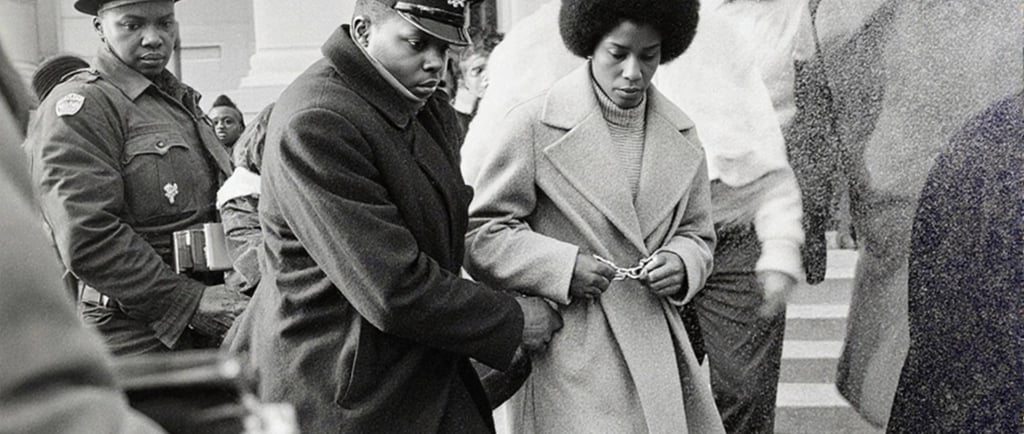
Recently, I came across an op-ed written by Columbia University graduate Natalie Sandoval. The article titled, “Liberals’ Favorite Race Grifter Glorifies Terrorist, Inadvertently Drags Harriet Tubman Down With Her,” was published in the Daily Caller. The terrorist that Sandoval is referring to is the late, great Assata Shakur. Although I was offended by this person referring to one of our (African descended people) freedom fighters as a terrorist, I was not shocked about a non-Black person speaking or writing in a hostile and dismissive tone about the Black experience. What these racists continue to fail to grasp is that their privileged position keeps them from viewing the world through the lens of the affected group. The result is a lack of understanding of the means used to advance and liberate Black people. Sandoval does not realize how her Eurocentrism and racism are the basis of her perspective, which is the impetus of this article.
One of the functions of colonial education is to shape our collective memory. Europeans easily accept historical lies as truth because they fit their narrative. But there is a constant struggle to get the Black community to accede to their historical narratives. That is why they relentlessly fight to negate Black or African-centered education. For instance, Sandoval’s begins her article with a criticism of Nikole Hannah-Jones, whose end-of-the-year tribute to Assata Shakur appears to be the motivation for the op-ed. She takes a slight dig at Hannah-Jones’ scholarship, by challenging her work on the “1619 Project,” particularly the claim that the American Revolution was motivated by slavery. The mention of the claims in the “1619 Project” had nothing to do with the subject matter, but it was an attempt to dismiss Hannah-Jones as a scholar, and the Black experience. Sandoval claims that Hannah-Jones’ evidence was weak, but she does not offer any evidence to refute this claim, nor does she explain why the evidence was weak. This is often a tactic used by racists; they present no counterargument or proof, and they tend to ignore and be dismissive of the facts, even in the face of evidence.
Anyone who does surface-level research can see that Hannah-Jones' argument of slavery being the cause, or at least one of the causes for the war for independence, has some credence. For instance, records show that on April 12, 1776, the Fourth Provincial Congress held a meeting. During this meeting, North Carolina’s assembly authorized the delegates to the Continental Congress to vote for independence. The resolutions were written in the minutes of their meeting and have become known as the Halifax Resolves. The resolutions were the culmination of a year of county-level conference discussions across the colony, and they were the first official action by a colony to call for severing ties with Britain and for independence for the colonies. I want to emphasize that North Carolina was the first state to formally call for the independence of the United Colonies.
One of the complaints in the Halifax Resolves was, “That Governors in different Colonies have declared Protection to Slaves who should imbrue their Hands in the Blood of their Masters.” According to sources, this:
“reveals another motivation behind North Carolina’s declaring independence from Great Britain: the colonists’ fears of armed slave rebellion, which was being explicitly encouraged at the time by Virginia governor Lord Dunmore’s offer of freedom to any enslaved person who took up arms for the Crown.”
North Carolina representatives were very clear about the motivation behind the call for independence. To give more context, the historical record reveals that John Murray, 4th Earl of Dunmore, issued Dunmore’s Proclamation. Due to unrest in the Virginia colony, in April 1775, Dunmore swore that if any injury or insult were offered to himself, he would declare freedom to the slaves, which alienated many of the slaveholding class. Then, in November of that year, Dunmore would issue his Proclamation.
Prior to North Carolina’s call for independence, discussions primarily centered on demands for greater rights as British subjects, rather than a push for separation from the Crown. It was ultimately the perceived threat to the institution of slavery that served as the decisive catalyst for independence.
But Sandoval is only getting started with her claims, as she continued to write with racist undertones and propaganda. She is bothered by the analogy of Shakur “being like a runaway slave,” and placed in the pantheon of freedom fighters, such as Nat Turner and Harriet Tubman. The reason she is bothered is that she sees the world through a racist lens. Sandoval cannot fathom the reality African Americans lived through during this period. African Americans were subjected to a society where racism was so prevalent that the government needed to pass Civil Rights legislation to protect the constitutional rights of Black people, and a time when African American leaders and organizers were being assassinated. It was people like Assata Shakur who decided to fight back that forced the government to make concessions. African Americans fought for rights and liberty, and many lost their life and freedom as a result. It is ignorance like that displayed by Sandoval, who knows nothing about Black history or the Black experience, that continues to threaten the attainment of true power and freedom for African peoples.
Continuing on her tirade, Sandoval’s ignorance gets the best of her yet again, as she mocks the idea that an all-white jury’s conviction of Shakur may have possibly been influenced by racism. She is obviously oblivious to American history to question this accusation. To express incredulity, she cannot possibly be aware of the history of the injustices perpetrated against African Americans by the judicial system. All white jurors have a long record of convicting Black people with little or no evidence in the United States. One can begin by researching the cases of George Stinney, the Scottsboro Boys, Walter McMillian, Joseph Green Brown, and James Cochran. Additionally, all white jurors are historically known to acquit perpetrators of crimes against Black people with overwhelming evidence, such as the murder of Medgar Evers, Emmett Till, Louis Allen, and Herbert Lee.
Finally, Sandoval ends her article with an enigmatic claim about the Underground Railroad: “Maybe this is a fitting historical analogy, giving the extensive mythology and outright fabrications surrounding the underground railroad.” What exactly she is alluding to is left for the reader's imagination. I doubt if she has read any books on the Underground Railroad. From the start, Sandoval demonstrated that she is an apologist for American colonialism and racism. It is no surprise, then, that she would see someone like Assata Shakur as a terrorist. Racists and apologists for colonialism and racism will continue to attack our scholars, freedom fighters, and our history because it threatens their privilege. This is why, every time we encounter these weak attempts to attack our history and experience, we must counter them with evidence-based arguments and facts. Something that Sandoval failed at miserably.
Who We are
An anti-imperialist Pan-Africanist organization dedicated to political education, organizing, and the advancement of African self-determination and sovereignty.
Quick Links
Get Involved
Attend an Event
Subscribe to Podcast
Connect With Us
Location: United States
Privacy Policy | Terms of Use
© 2026 We Charge Colonialism. All Rights Reserved.